
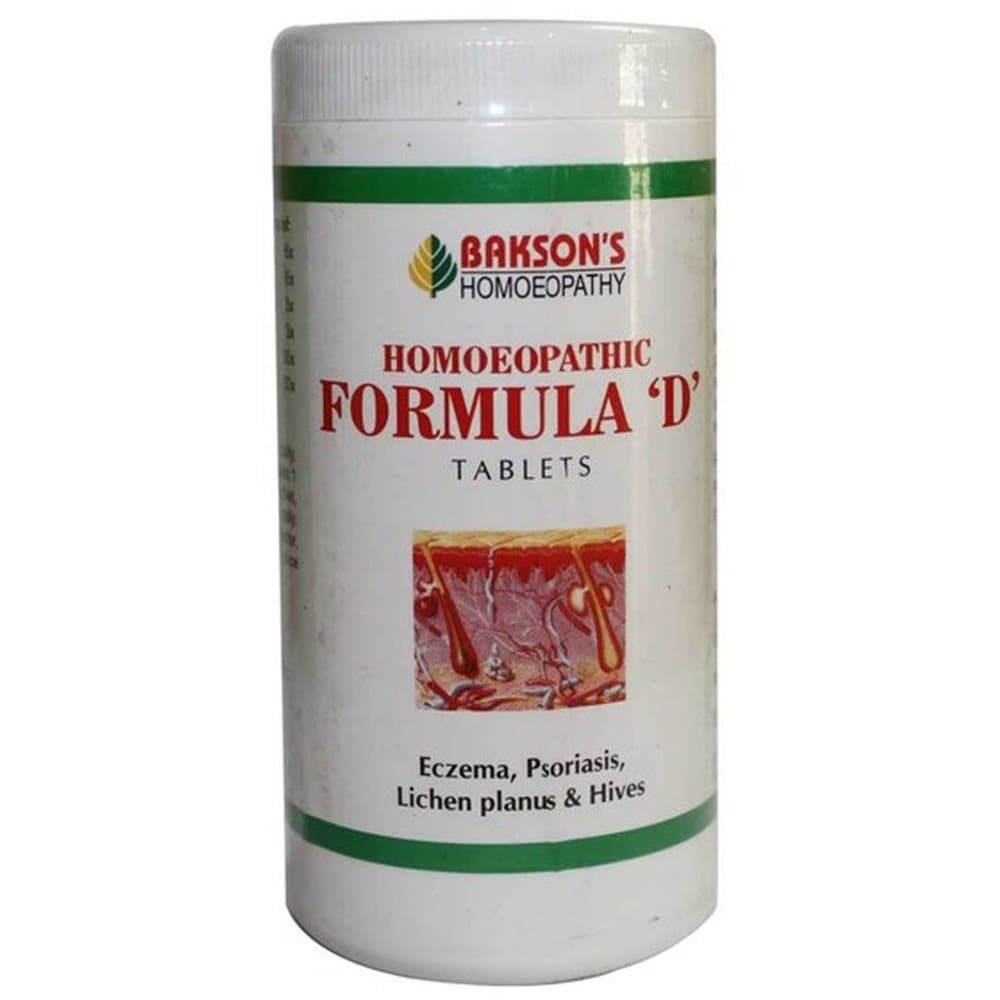
FORMULA 'D' TABLETS 200 TABLETS
SKU: 190186
Dermatitis refers to the inflammation of skin and comprises of a range of ailments. In general, dermatitis presents with dry, swollen and red skin, causes and features of which, vary according to the type of dermatitis. The common symptoms to all types of dermatitis are – rashes, dry cracked skin,
Select Volume: 200 Tablets
- Standard delivery in 3–7 business days
- Cash on Delivery available
- Guaranteed refunds / returns within 7 days of delivery
Dermatitis refers to the inflammation of skin and comprises of a range of ailments. In general, dermatitis presents with dry, swollen and red skin, causes and features of which, vary according to the type of dermatitis.
The common symptoms to all types of dermatitis are – rashes, dry cracked skin, itching, blisters, stinging or burning pain, redness and swelling.
Types of Dermatitis:
There are many types of dermatitis known, the most common ones are:
Atopic Dermatitis or Eczema: It is a hypersensitivity reaction to various allergens, which is a chronic condition and occurs most commonly in children. Personal or family history of eczema, allergies, hay fever or asthma is a major risk factor. It presents with red and itchy skin, red to brownish-grey patches, small raised bumps that may leak fluid and crust over on scratching, skin is cracked, thickened, raw and swollen from scratching. It can be accompanied with asthma or hay fever.
Allergic Contact Dermatitis: It presents with red, itchy, scaly rashes with visible borders due to contact or exposure to chemicals or elements like nickel, fragrances, hair dyes, preservatives, rubber and latex products.
Irritant Contact Dermatitis: Presents with a rash affecting only a small area with no boundaries. It appears immediately on exposure to irritants like harsh soaps, cleansers and solvents.
Dyshidrotic Dermatitis: It presents with a sudden occurrence of a rash with small, itchy blisters on palms, soles and along the sides of fingers and toes. Small itchy blisters are the most characteristic sign of this type of dermatitis. Skin is red, cracked, and sweaty. Cause is unknown, but risk factors include a positive family history of eczema, allergies, stress, contact with metals, sweaty hands or feet, etc.
Seborrhoeic Dermatitis: Also known as cradle cap in babies, this affects most commonly the scalp, but can also affect face and chest. 3 months and younger babies often develop cradle cap with crusty yellow or brown scales on their scalp, which resolves before the age of 1 year. In adults, lesion can be seen on face, middle part of chest, around umbilicus, on buttocks, in skin folds, below breasts, etc. it presents with itchy or burning skin with scales which are yellow or white and oily, that flake off easily.
Neurodermatitis, lichen simplex chronicus: It starts with an itchy patch of skin which is worse on scratching which creates an itch-scratch cycle resulting in a thick and leathery skin. It is commonly seen on neck, wrists, forearms, legs or anal region.
Nummular Dermatitis, discoid eczema: It is a chronic condition presenting with coin-shaped spots on the skin which are itchy and well-defined and may ooze clear fluid or become dry and crusty. It often develops after a skin injury like burn, abrasion or insect bite and lasts for several months.
Stasis Dermatitis: It presents with skin changes occurring due to poor blood circulation or venous stasis. It is more common in people aged 50 years or more and women are more at risk. Symptoms include red, yellow or brown skin and swelling around the ankles, varicose veins, itching, pain, thickening of skin around ankles or shin, etc.
Dermatitis neglecta: It occurs from a lack of hygiene presenting with scales on the skin which are stubborn and stuck to the skin, and hyperpigmentation. People with chronic disability, old age, sensitive skin, recent trauma or certain mental health conditions are more at risk.
Expiry: 5 years from the date of manufacturing.
Manufactured in India by: Bakson Drugs and Pharmaceuticals Pvt. Ltd. Chouli Shahbuddinpur, Pargana Bhagwanpur, The. Roorkee-247661, Distt Haridwar, UK, India ,Customer care executive Mail id and contact details-customercare@buybakson.com, 18002572829
Disclaimer: The information provided herein on request, is not to be taken as a replacement for medical advice or diagnosis or treatment of any medical condition. DO NOT SELF MEDICATE. PLEASE CONSULT YOUR PHYSICIAN FOR PROPER DIAGNOSIS AND PRESCRIPTION.
Indications
Dosage: For Dry / Wet Eczema: Adults: Start with one tablet Monday & Thursday, twice a week for two weeks. Improvement is seen, as roughness and itching of skin reduces. Continue the medicine till the symptoms disappear. In case of no improvement after fifteen days, you may increase to one tablet alternate day for two weeks. In certain sensitive patients there may be aggravation in that case you may reduce the dosage to one tablet once in a week. Based upon the response after one month the dosages can be increased in case of no improvement which is very rare from alternate day to once a day, up to twice daily at the interval of 15 days each. Usually most of the patients respond well within the first month. Maintenance dosage of twice a week is to be taken till patient is completely symptom free. Children: Start with one tablet once a week. As the improvement increases, you may reduce the dosage to one tablet once in ten days and then one tablet once fortnightly. Maintenance dosage of once fortnightly is to be taken till the child is completely symptom free. For Lichen planus: Adults: Start with one tablet on alternate day. Improvement is seen, as thickness and itching of skin reduces. Continue the medicine till the symptoms disappear. In case of no improvement after fifteen days, you may increase to one tablet once a day for two weeks. In certain sensitive patients there may be aggravation in that case you may reduce the dosage to one tablet on Monday & Thursday, twice in a week. Based upon the response after one month the dosages can be increased in case of no improvement from once a day, up to twice daily at the interval of fifteen days each. Usually most of the patients respond well within the first month.
Key Ingredients
Dermatitis refers to the inflammation of skin and comprises of a range of ailments. In general, dermatitis presents with dry, swollen and red skin, causes and features of which, vary according to the type of dermatitis. The common symptoms to all types of dermatitis are – rashes, dry cracked skin, itching, blisters, stinging or burning pain, redness and swelling. Types of Dermatitis: There are many types of dermatitis known, the most common ones are: Atopic Dermatitis or Eczema: It is a hypersensitivity reaction to various allergens, which is a chronic condition and occurs most commonly in children. Personal or family history of eczema, allergies, hay fever or asthma is a major risk factor. It presents with red and itchy skin, red to brownish-grey patches, small raised bumps that may leak fluid and crust over on scratching, skin is cracked, thickened, raw and swollen from scratching. It can be accompanied with asthma or hay fever. Allergic Contact Dermatitis: It presents with red, itchy, scaly rashes with visible borders due to contact or exposure to chemicals or elements like nickel, fragrances, hair dyes, preservatives, rubber and latex products. Irritant Contact Dermatitis: Presents with a rash affecting only a small area with no boundaries. It appears immediately on exposure to irritants like harsh soaps, cleansers and solvents. Dyshidrotic Dermatitis: It presents with a sudden occurrence of a rash with small, itchy blisters on palms, soles and along the sides of fingers and toes. Small itchy blisters are the most characteristic sign of this type of dermatitis. Skin is red, cracked, and sweaty. Cause is unknown, but risk factors include a positive family history of eczema, allergies, stress, contact with metals, sweaty hands or feet, etc.
Dosage & Directions for Use
Dermatitis refers to the inflammation of skin and comprises of a range of ailments. In general, dermatitis presents with dry, swollen and red skin, causes and features of which, vary according to the type of dermatitis. The common symptoms to all types of dermatitis are – rashes, dry cracked skin, itching, blisters, stinging or burning pain, redness and swelling. Types of Dermatitis: There are many types of dermatitis known, the most common ones are: Atopic Dermatitis or Eczema: It is a hypersensitivity reaction to various allergens, which is a chronic condition and occurs most commonly in children. Personal or family history of eczema, allergies, hay fever or asthma is a major risk factor. It presents with red and itchy skin, red to brownish-grey patches, small raised bumps that may leak fluid and crust over on scratching, skin is cracked, thickened, raw and swollen from scratching. It can be accompanied with asthma or hay fever. Allergic Contact Dermatitis: It presents with red, itchy, scaly rashes with visible borders due to contact or exposure to chemicals or elements like nickel, fragrances, hair dyes, preservatives, rubber and latex products. Irritant Contact Dermatitis: Presents with a rash affecting only a small area with no boundaries. It appears immediately on exposure to irritants like harsh soaps, cleansers and solvents. Dyshidrotic Dermatitis: It presents with a sudden occurrence of a rash with small, itchy blisters on palms, soles and along the sides of fingers and toes. Small itchy blisters are the most characteristic sign of this type of dermatitis. Skin is red, cracked, and sweaty. Cause is unknown, but risk factors include a positive family history of eczema, allergies, stress, contact with metals, sweaty hands or feet, etc.
Safety Information
If symptoms persist, worsen or recur frequently, consult a registered medical practitioner Keep this and all medicines out of the reach of children. Store in a cool, dark & dry place. REDUCTION IN THE INTENSITY OF ALLERGIC MANIFESTATIONS The graph depicts how Bakson’s Homoeopathy helps in lowering the intensity of symptoms (smaller subsequent peaks), in decreasing the duration of the episodes (area under the peaks) and in increasing the time gap between subsequent episodes. Eventually the patient acquires enough resistance to remain symptom free, despite repeated exposure to the same allergens. For better results : Take nutritious diet. Avoid application of cosmetic creams and lotions. Avoid fatty food like chocolates, nuts, dry fruits, spicy food etc. which might increase the activity of sebaceous glands. Exercise regularly. An anti-inflammatory, anti-allergic and anti-pruritic combination that offers relief from skin ailments like: Eczema Lichen planus Extreme dryness, cracks & excessive scaling Composition: Calcarea fluorica 3x, Calcarea sulphurica 3x , Kali sulphuricum 3x, Natrum sulphuricum 3x, Arsenicum album 6x & Rhus toxicodendron 3x. Indications: For Eczema & Lichen planus characterised by redness, swelling, intense itching, eruptions, oozing, extreme dryness, cracks & excessive scaling. Dosage: For Dry / Wet Eczema: Adults: Start with one tablet Monday & Thursday, twice a week for two weeks. Improvement is seen, as roughness and itching of skin reduces. Continue the medicine till the symptoms disappear. In case of no improvement after fifteen days, you may increase to one tablet alternate day for two weeks. In certain sensitive patients there may be aggravation in that case you may reduce the dosage to one tablet once in a week.
Product Highlights
Uses & Benefits
Dermatitis refers to the inflammation of skin and comprises of a range of ailments. In general, dermatitis presents with dry, swollen and red skin, causes and features of which, vary according to the type of dermatitis. The common symptoms to all types of dermatitis are – rashes, dry cracked skin, itching, blisters, stinging or burning pain, redness and swelling. Types of Dermatitis: There are many types of dermatitis known, the most common ones are: Atopic Dermatitis or Eczema: It is a hypersensitivity reaction to various allergens, which is a chronic condition and occurs most commonly in children. Personal or family history of eczema, allergies, hay fever or asthma is a major risk factor. It presents with red and itchy skin, red to brownish-grey patches, small raised bumps that may leak fluid and crust over on scratching, skin is cracked, thickened, raw and swollen from scratching. It can be accompanied with asthma or hay fever. Allergic Contact Dermatitis: It presents with red, itchy, scaly rashes with visible borders due to contact or exposure to chemicals or elements like nickel, fragrances, hair dyes, preservatives, rubber and latex products. Irritant Contact Dermatitis: Presents with a rash affecting only a small area with no boundaries. It appears immediately on exposure to irritants like harsh soaps, cleansers and solvents. Dyshidrotic Dermatitis: It presents with a sudden occurrence of a rash with small, itchy blisters on palms, soles and along the sides of fingers and toes. Small itchy blisters are the most characteristic sign of this type of dermatitis. Skin is red, cracked, and sweaty. Cause is unknown, but risk factors include a positive family history of eczema, allergies, stress, contact with metals, sweaty hands or feet, etc.
Indications
Dosage: For Dry / Wet Eczema: Adults: Start with one tablet Monday & Thursday, twice a week for two weeks. Improvement is seen, as roughness and itching of skin reduces. Continue the medicine till the symptoms disappear. In case of no improvement after fifteen days, you may increase to one tablet alternate day for two weeks. In certain sensitive patients there may be aggravation in that case you may reduce the dosage to one tablet once in a week. Based upon the response after one month the dosages can be increased in case of no improvement which is very rare from alternate day to once a day, up to twice daily at the interval of 15 days each. Usually most of the patients respond well within the first month. Maintenance dosage of twice a week is to be taken till patient is completely symptom free. Children: Start with one tablet once a week. As the improvement increases, you may reduce the dosage to one tablet once in ten days and then one tablet once fortnightly. Maintenance dosage of once fortnightly is to be taken till the child is completely symptom free. For Lichen planus: Adults: Start with one tablet on alternate day. Improvement is seen, as thickness and itching of skin reduces. Continue the medicine till the symptoms disappear. In case of no improvement after fifteen days, you may increase to one tablet once a day for two weeks. In certain sensitive patients there may be aggravation in that case you may reduce the dosage to one tablet on Monday & Thursday, twice in a week. Based upon the response after one month the dosages can be increased in case of no improvement from once a day, up to twice daily at the interval of fifteen days each. Usually most of the patients respond well within the first month.
Key Ingredients
Dermatitis refers to the inflammation of skin and comprises of a range of ailments. In general, dermatitis presents with dry, swollen and red skin, causes and features of which, vary according to the type of dermatitis. The common symptoms to all types of dermatitis are – rashes, dry cracked skin, itching, blisters, stinging or burning pain, redness and swelling. Types of Dermatitis: There are many types of dermatitis known, the most common ones are: Atopic Dermatitis or Eczema: It is a hypersensitivity reaction to various allergens, which is a chronic condition and occurs most commonly in children. Personal or family history of eczema, allergies, hay fever or asthma is a major risk factor. It presents with red and itchy skin, red to brownish-grey patches, small raised bumps that may leak fluid and crust over on scratching, skin is cracked, thickened, raw and swollen from scratching. It can be accompanied with asthma or hay fever. Allergic Contact Dermatitis: It presents with red, itchy, scaly rashes with visible borders due to contact or exposure to chemicals or elements like nickel, fragrances, hair dyes, preservatives, rubber and latex products. Irritant Contact Dermatitis: Presents with a rash affecting only a small area with no boundaries. It appears immediately on exposure to irritants like harsh soaps, cleansers and solvents. Dyshidrotic Dermatitis: It presents with a sudden occurrence of a rash with small, itchy blisters on palms, soles and along the sides of fingers and toes. Small itchy blisters are the most characteristic sign of this type of dermatitis. Skin is red, cracked, and sweaty. Cause is unknown, but risk factors include a positive family history of eczema, allergies, stress, contact with metals, sweaty hands or feet, etc.
Safety Information
If symptoms persist, worsen or recur frequently, consult a registered medical practitioner Keep this and all medicines out of the reach of children. Store in a cool, dark & dry place. REDUCTION IN THE INTENSITY OF ALLERGIC MANIFESTATIONS The graph depicts how Bakson’s Homoeopathy helps in lowering the intensity of symptoms (smaller subsequent peaks), in decreasing the duration of the episodes (area under the peaks) and in increasing the time gap between subsequent episodes. Eventually the patient acquires enough resistance to remain symptom free, despite repeated exposure to the same allergens. For better results : Take nutritious diet. Avoid application of cosmetic creams and lotions. Avoid fatty food like chocolates, nuts, dry fruits, spicy food etc. which might increase the activity of sebaceous glands. Exercise regularly. An anti-inflammatory, anti-allergic and anti-pruritic combination that offers relief from skin ailments like: Eczema Lichen planus Extreme dryness, cracks & excessive scaling Composition: Calcarea fluorica 3x, Calcarea sulphurica 3x , Kali sulphuricum 3x, Natrum sulphuricum 3x, Arsenicum album 6x & Rhus toxicodendron 3x. Indications: For Eczema & Lichen planus characterised by redness, swelling, intense itching, eruptions, oozing, extreme dryness, cracks & excessive scaling. Dosage: For Dry / Wet Eczema: Adults: Start with one tablet Monday & Thursday, twice a week for two weeks. Improvement is seen, as roughness and itching of skin reduces. Continue the medicine till the symptoms disappear. In case of no improvement after fifteen days, you may increase to one tablet alternate day for two weeks. In certain sensitive patients there may be aggravation in that case you may reduce the dosage to one tablet once in a week.
Frequently Asked Questions
Customer Reviews
Loading reviews…
Write a Review
Log in to get a Verified Purchase badge on your review — or just write one below.
Your Rating
0/1000
Up to 5 attachments · photos to 8 MB, video to 64 MB.